Add your own title and intro here (Change this under Settings -> General -> Tagline)

Author: waylonmccarthy

Two Students, One Language; Our Python Story

Over the course of this semester, we embarked on a collaborative exploration into the world of Python programming. With zero prior experience, our goal was to immerse ourselves in the fundamentals of coding through hands-on learning, guided tutorials, and self-driven mini-projects. Although originally intended as a complement to our resumes and job applications, the project quickly evolved into a rewarding and often challenging digital journey. While the project left us with an interest in the topic and a good start to developing ourselves a skill in the area, it also yielded an unexpected skill; the ability to use technology as a useful supplement to any learning process, a skill which is applicable to any topic or field, and a skill that is demanded in a society as digitally saturated as ours is today.

Phase 1: Getting to know our resources and learning the Python basics

After returning from our spring break trip, we dipped our toes in the bath of Python using online tutorials such as W3Schools as our starting point. These resources offered us a structured yet flexible approach to grasp foundational concepts. We completed a few tutorials covering topics such as:

  • Python syntax
  • Writing and using comments
  • Variable assignment
  • Mathematical operations
  • Basic data types (strings, floats, integers)

We didn’t limit ourselves to one platform—we also leveraged ChatGPT and other AI resources to clarify concepts and compile command references, helping us move from understanding commands to actually applying them. This phase allowed us to start writing our own Python code for the very first time! This phase was also important in that it got us used to navigating our resources productively and maximize their effectiveness.

Phase 2: Writing our first file

Excited by our progress, we were eager to make something that we could call our own. Although we struggled at first to find a project within our skill level, we eventually settled on a number guessing game. With this project, we learned to:

  • Use conditional logic with ‘if’/’else’ statements.
  • Use input/output statements to interact with the user.
  • Generate random numbers using the ‘random’ module.
  • Build loops.
  • Validate user input and troubleshoot potential crashes.

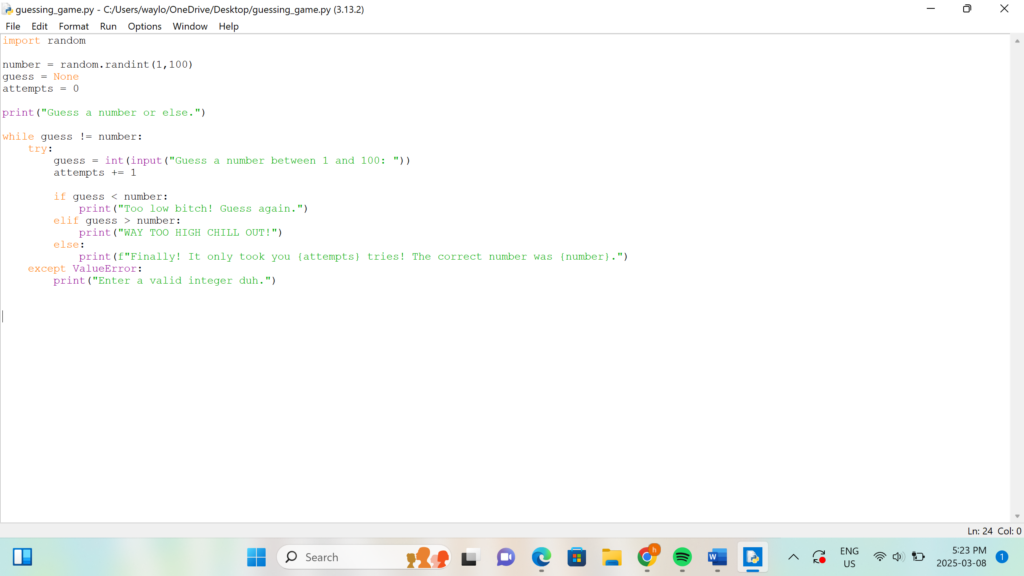
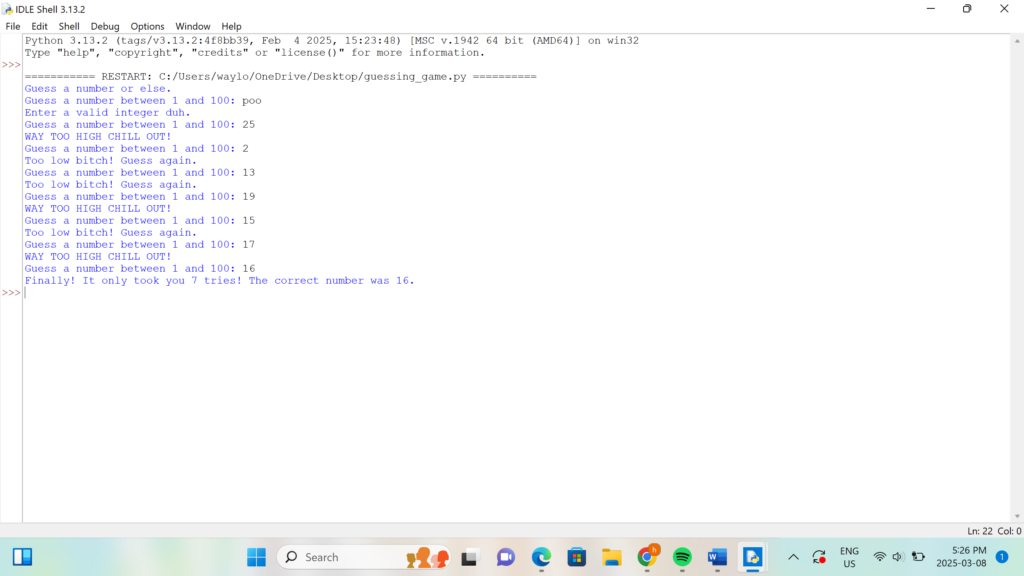
Our code-genius friend Nik helped us troubleshoot problems with our code and difficulties we faced when launching files via the shell. With the help of hints along the way, players could enter guesses until they discovered the right number. In an exhilarating first coding success, we even added safety logic for non-integer entries – a win in our books!

Phase 3: Biting off as much as we could chew

For our final and most ambitious project yet, we decided to take on the challenge of building a text-based adventure game called Dungeon Explorer. This was a choose-your-own-adventure game thatgot us used to a lot more new and advanced coding concepts, while extending our skills with some that we’d seen before:

  • Game state management: tracking player health, inventory, and room progression.
  • Randomization: using Python’s random module for unpredictability (monster strength, item drops, etc.).
  • Loops and nested decisions: enabling the game to continue until a player wins or dies.

Compared to our last game, this project required a lot longer code, more game elements, and more intricate logic, but it also felt by far the most rewarding. We started to think like developers, creating modular logic, planning outcomes, and addressing errors as they came up.
Future Steps

While Dungeon Explorer marked a huge milestone in our learning, we’re currently still in the process of completing another project, our to-do list tracker. Although we have been encountering the most issues yet with this one, it is teaching us that learning to code is as much about patience and persistence as it is about syntax. Each obstacle has taught us more than just coding—it’s taught us how to think, troubleshoot, and grow through the process.
Deep Dive Inquiry 3: Fighting Digital Dragons

It has been quite a while since our last blog post on our Python journey, but that doesn’t mean a lost hasn’t happened since then. During this time, Lyndsay and I have a major project; a text-based choose your own adventure game.

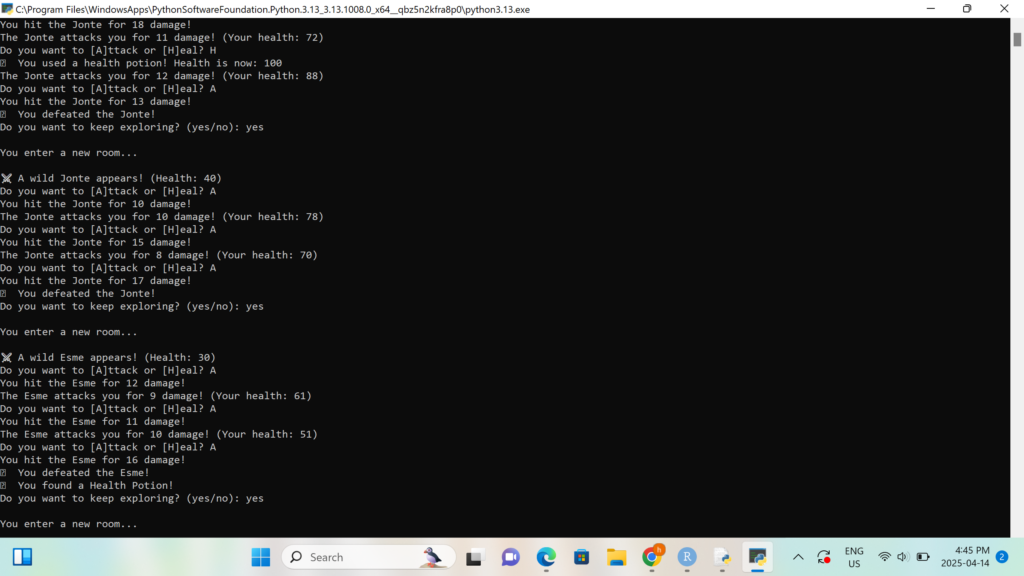
The name of our game was ‘Dungeon Explorer’. In this game, the player creates their own character, which they use to explore the rooms of a dungeon while fighting monsters. The player wins if they fight off all of the monsters and reach the final room, and they lose if they die.

This type of project involved a lot more new elements than our last number guessing game, and required much longer code, but we were up for the challenge. Here are some of the new elements we learned about and were able to employ:

  • Game state management: There were multiple aspects of the game that we needed for the game to be able to track as the player progresses, such as inventory, health, and the number of rooms they have entered.
  • Game unpredictability: using the random module, we were able to add make the difficulty of the game variable over multiple rounds, by making monster spawning, item dropping, and damage/healing random.
  • Looping: we created a loop command to keep the game going until the player wins, quits, or dies, in which we nested various decisions for the player to make.

Here is a snippet of me taking the game out for a test drive. If I must say, it’s actually pretty fun!

During this time, we were also working on a to-do list tracker, but we are still troubleshooting a couple issues with it.

Digital Literacy in Primary Education

Digital literacy is a concept that has always contrasted from other subjects like science and math for me. This is because throughout my education, it was not something that was emphasized to be important enough to merit its own distinction; instead it has always been covertly interwoven into the content of other courses. Digital literacy, however, is a fundamental aspect of education, which in the almost completely online nature of the current meta, is vitally applicable to almost every field of study.

Going through the BC Post-Secondary Digital Literacy Framework invoked a lot of reflection on this aspect of my education. The B.C. Post-Secondary Digital Literacy Framework is a comprehensive guide that was developed to improve and allow individuals to assess the digital literacy skills and knowledge of post-secondary students across B.C., by outlining essential skills and practices needed to navigate, create, and participate effectively and inclusively in digital environments across post-secondary communities.

The framework identifies 8 core competencies of digital literacy: ethical and
legal; technology; information literacy; digital scholarship; communication and
collaboration; creation and curation; digital wellbeing; and community-based learning. With clearly stated expectations catered to a variety of roles—students, instructors, graduates, and all digital citizens alike—each theme highlights an essential aspect of being digitally literate.

The emphasis on digital wellbeing struck a particularly deep chord with me. This skill affirms the significance of establishing boundaries with technology, carefully curating your digital persona, and placing a high priority on mental health in online settings in an age of information overload and algorithm-driven anxiety.

Digital literacy is a dynamic lifelong learning process that cannot be simply learned from a single guide or course. The digital world has evolved quickly and dramatically over its course, and will continue to do so for the foreseeable future; as the it evolves, our literacy needs to progress and conform with it. This framework gives educators and students the skills and mindset they need to navigate and co-create the digital futures we desire. It serves as a potent reminder that being digitally literate entails having traits that go far beyond the screen, such as knowledge, respect, inclusivity, and flexibility.

In a province as diverse and interconnected as British Columbia, this framework has the potential to be transformative—I find the receptiveness of the demographic to be the limiting factor, rather than the thoroughness and intuition of the framework.

Annotation is for Everyone: Annotation as a Fundamental of Literacy and Communication

Annotation to me has always been something quite specific and concerted; when I think of annotation, I of think sticky notes in textbooks, comments on Google Docs, and dreaded English assignments. Dr. Remi Kalir, however, asserts that annotation is a social, political, and widely encompassing practice, influencing how we interact with the outside world, reaching far beyond a study technique. If you think about, this blog post is in a sense an annotation, and any thoughts or comments that I might provoke from you here would be annotations as well.

The complex, multi-layered realm of social annotation—how we read and write together, why it matters, and what it tells about power, learning, and community—was recently explored by Dr. Kalir in a discussion led by Dr. Valerie Irvine.

At its core, annotation is simple: it’s a note added to a text. But Kalir urges us to see annotation as a literacy practice—a way to not just understand texts, but also to engage critically with the world around us. From sticky notes on recipes to projected messages on protest walls, annotation is everywhere. It’s how we clarify, contest, question, and connect.

Social annotation depthens this concept with collaboration. It invites people to comment, question, and co-create meaning by putting them in the margins. Digital annotations made possible by tools like Hypothesis can be shared publicly with the world or privately with a class.

Social annotation isn’t simply about technology; it’s about education. It gives teachers new avenues for instruction and interaction. Consider starting a lesson by asking students to annotate the syllabus together, marking questions, offering feedback on rules, and helping to create the classroom atmosphere. It is reflective, democratic, and participatory.

Kalir’s work also emphasizes that annotation, like many aspects of literacy, is something powerful. From stop signs modified to acknowledge Indigenous lands to projected images on monuments during racial justice protests, annotation can be a way to challenge dominant systems and reimagine social realities.

In his forthcoming book Re/Marks on Power, Kalir explores how annotation is intertwined with political discourse. The act of “adding a note” becomes a form of resistance and reclamation.

Annotation isn’t just for academics; it’s for anyone who can read, write, observe, reflect; it’s for anyone that can form original thoughts. Whether you’re jotting down thoughts in a book, leaving a sticky note on the fridge, or using digital tools to respond to a peer’s blog post, you’re participating in a practice that’s as old as writing itself.

Digital Literacy with EVERYONE in Mind

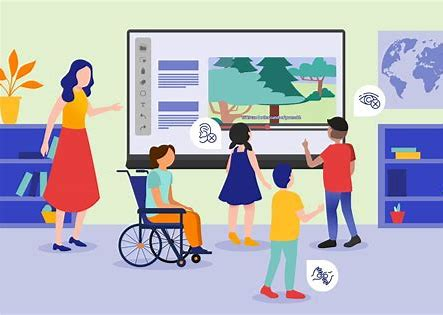
When I hear ‘accessibility’, I think of wheelchair ramps, braille subtexts, and the described video message before TV shows as a kid. However, Charlie Watson’s talk at UVic about digital accessibility and assistive technology made me realise how widespread – and vital – accessibility is.

Watson, who oversees the Adaptive Technology Program at UVic’s Centre for Accessible Learning, covered everything from high-tech gadgets like braille displays to minor yet significant adjustments we may make in a Word document or a Zoom chat in his informative presentation.

Watson’s criticism of the phrases adaptive and assistive technology was the first thing that caught my attention. In reality, these tools are part of a continuum, but we frequently isolate “special” technology for individuals with disabilities from the tools that everyone uses, such as screen magnifiers or voice dictation. Consider using automated subtitles in a noisy café or text-to-speech while driving. Everyone benefits from accessibility, or put so bluntly by Watson: “Ability is temporary. You will be disabled one day. Design for that now.”

We need to stop expecting people to change to fit our systems. We need to design systems that fit people. Whether that’s ensuring captions are accurate, documents are screen-reader friendly, or diagrams aren’t cluttered and color-dependent, small changes go a long way. As someone who never thought twice about hyperlink text, I now cringe when I see “Click here.” Charlie’s point about screen reader users encountering a wall of meaningless links hit hard: access starts with intentional design.

It was impressive how many options were showcased, ranging from dictation software and other keyboards to immersive reading modes and haptic visuals. The fact that so many are already included in devices or are publicly accessible, such as Otter.ai for transcriptions or Microsoft Edge’s Immersive Reader, was even more startling. Access isn’t always the problem; awareness is.

Charlie also reminded us that innovation doesn’t have to be costly by bringing up the community-built 3D printed technology. It can be open-source, creative, and cooperative.

Charlie’s presentation was a call-in rather than merely a how-to. A reminder that charity is not the same as accessibility. It’s fairness. The “selfish” reason to care is that accessible design benefits everyone, including the exhausted reader, the ageing professor, the parent with a sleeping infant, and the overworked student. When the digital world shifts towards equity and usability, we all gain.

Implementation of Equity and Inclusivity as a Forethought rather than through Retroaction

Marginalization of minorities has been prevalent in practically every institution, framework, and principle of social development in Western history. It has only been recently that significant action has been taken to heed equity and diversity in these areas, which has in some cases resulted in major overhaul of such structures. Despite this however, the issues still manifests itself almost everywhere, most significantly so in the more complex aspects of society; income, judicial systems, politics, etc. When these systems have been under development with little consideration of these minorities for so long, it takes significant time and effort to effect meaningful change.

Without consideration of equity and diversity from the very beginning, the disparity it generates only becomes more and more magnified as the system develops. This is why when development emerges in new areas, it is vital to take careful consideration of diversity seriously and immediately. One of these frameworks is digital literacy: the digitization of the modern world is fairly recent, and overlaps with the combatting of underrepresentation and systemic marginalization and prejudice. Therefore, as digital literacy becomes a more pervasive issue and undergoes significant development and institutionalization, a rare opportunity emerges to make diversity and inclusion a fundamental element of digital literacy, where every progression and expansion proceeds with its consideration. This is not to say that there is no injustice or inequity already established in digital literacy, but it makes it so much easier to tackle these issues when they are not so anciently entrenched.

Maha Bali is one of the many advocates bringing light to this issue and affirming its vitality. She suggests a variety of methods for attacking inequity in digital literacy, as well as proactive methods to maintain equity for the future. One of these is a model she calls the ‘Rumi Cheese Model’, based off of the Swiss Cheese Model, a widely accepted and acclaimed accident causation and risk analysis model. The Swiss Cheese Model likens a system to multiple slices of Swiss cheese stacked consecutively, in which each each layer represents a failure defence, and each hole represents a lapse or weakness in the defense. The model theorizes that the failure of a system is never due to a fault in any one defence, but rather that it occurs where the ‘holes’ in multiple defences align when they are compounded.

Although the Swiss Cheese Model finds its most prominent applications in safety protocol, such as emergency response protocols and aviation safety, or in engineered systems, such as computer software and complex machinery, Bali applies the model to digital literacy. She does so however, with a caveat, which allows the mechanical nature of the model to be applicable to the socially delicate and complex nature of digital literacy. The ‘Rumi Cheese Model’, likens the protection of digital literacy from the adulateration of inequity to slices of Rumi cheese rather than Swiss, with the difference being that Rumi cheese contains black peppercorns that Swiss does not, but with all of the same holes that Swiss cheese does. The black peppercorns are a polarizing incorporation; some love them while others find them to ruin the cheese. This polarization is analogous to the human variability associated with diversity, where no one ‘defense’, or accomodation, is favourable for the demographic to which the accomdation was designed for. In the Swiss Cheese Model, a defense can either fail or withstand; there is no in-between, which does not hold true in the context of digital literacy. This emphasises the importance of humanizing digital literacy in establishing and maintaining equity, diversity, and inclusion, rather than simplifying it or attempting to conform it to a mechanical model.

Using AI as a Learning Partner, not as a Shortcut

After diving into the recent conversations and literature around generative AI in education, I find myself both energized and conflicted. Lucas Wright’s practical use of AI for day-to-day tasks like drafting emails and managing knowledge repositories gave me a tangible sense of how AI can alleviate mental clutter and help streamline routine academic workflows. Meanwhile, Mariel Miller’s discussion on AI as a collaborator in learning – capable of offering personalized, accessible, and even creative support – paints a hopeful picture of what’s possible when students engage with AI thoughtfully and critically. But she also warns of over-reliance, reminding us that learning isn’t just about completing tasks — it’s about doing the hard cognitive work ourselves. I’ve realized that efficiency, while tempting, can come at the cost of deeper understanding if we’re not mindful of how and when we use these tools.

Layered on top of that was the speculative article from the Asian Journal of Distance Education, which creatively explores both utopian and dystopian futures of AI in learning. It made me reflect on how we, as learners, are shaping that future every time we choose to engage with AI — whether for convenience or creativity, enhancement or escape. One of the most thought-provoking takeaways for me was the idea that AI should serve as a partner, not a replacement — supporting human agency rather than diminishing it. There’s no doubt we’re at a turning point. I’m now more committed to asking better questions when I use AI, thinking not just about what I’m getting out of it in the moment, but how it’s impacting my growth long-term. If we can hold onto that awareness, maybe we really can find a balance that honors both human curiosity and machine efficiency.

Deep Dive Inquiry 2 – Our First File

Learning Python has been an emotional rollercoaster for us. Never in my life have I experienced such intense frustration followed by pure glee and satisfaction about 5 minutes later. Today was our second session in saga of learning Python, in which we had aimed to create our first small project together. Because we were having trouble coming up with a project that would be achievable within our scope, as we aren’t very familiar with the extent our skills can be applied yet, we asked generative AI chatbot ChatGPT to think of a small beginner level project to challenge us with, and it came up with: the infamous number-guessing game. Of course, we were up for the challenge!

Although we already had some idea of what our code would need to look like based off of what we already knew, we did have to refer back to some W3Schools tutorials for refreshers on certain things, such as != and += notations for making statements. Today, we also learned how to use the Python shell as opposed to the main console, and we learned how to create a file and learned how to run a file in the shell. We were having trouble understanding this concept, so we called longtime friend and Python enthusiast Nik.

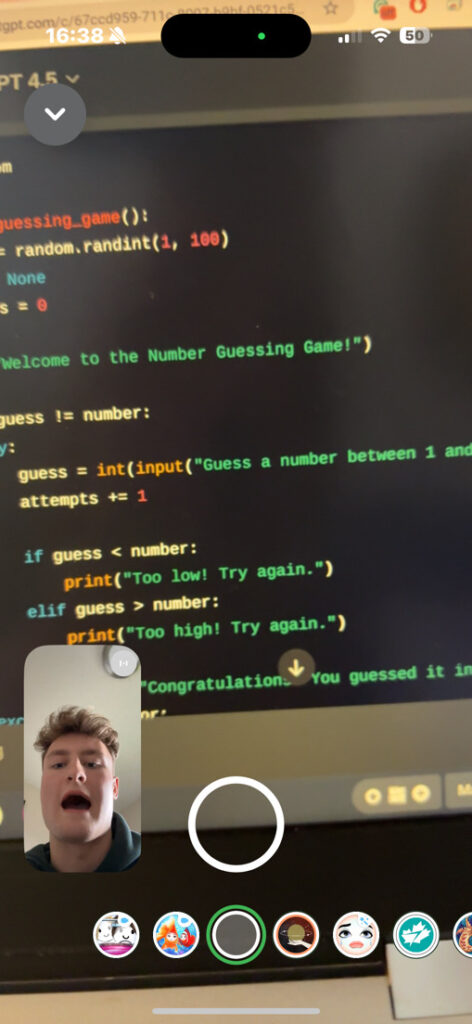
After a few unsuccessful runs with Nik troubleshooting in between, we finally found success! Here is the code to our new game:

The player enters random numbers until they guess the correct one, getting hints on which way to steer their guessing based off of their last guess. To avoid crashing, we also have a protective line for non-integer entries. Here is an example of someone playing our game:

The feeling of triumph when we pressed ‘Run’ and red text didn’t show up was a feeling like no other.

Goals for Next Session

Now that we have started built ourselves a solid foundation in Python, and seeing as we are now in our final month of classes, Lyndsay and I will be starting our final project in our next few learning sessions. Although our learning has by no means progressed to the point that we were aiming for when we started this process, we want our final project to be part of the learning process as well, rather than simply a reflection/ show of what we had learned beforehand. Today was actually really fun, and now Lyndsay and I are itching to get started on our next task!

Deep Dive Inquiry 1 – Familiarizing Ourselves with Python

After a much needed relaxation in Mexico over reading break, Lyndsay and I were ready to jump into our project. Python is widely versatile and expansive, so we did not find a linear, rigid learning approach to be appropriate. Instead, Lyndsay and I are going to try to implement as many learning methods as possible to experiment and find wat’s right for us.

For our first session, we familiarized ourselves with the resource W3Schools, a free educational website with various tutorials. We worked through 5-7 tutorials, each time gaining a new basic Python skill. We first worked through the introductory tutorials, learning the fundamental commands, before moving on to some more specific tutorials. We learned how to work around Python syntax, we learned how to make comments, and we learned how to assign variables and what the basic variable types were. We also are now able to make mathematical commands, which we supplemented a more exhaustive list of commands using ChatGPT, and we also learned about the different data types, such as float and string data.

Goals for Our Next Session

For our next session, we are aiming to complete a small project. Lyndsay and I have decided to either create an interactive quiz to showcase our conceptual understanding thus far, or possibly to create a functional budget tracker. Although functionally it is likely to be relatively frivolous, we find it important for our learning progress to have a tangible milestone such as something like this, and we think it will be a fun way to make the learning process more engaging and challenging.

The Role of Critical Thought in Digital Literacy: The SIFT Method

Every piece of media that I consume – whether that be a meaningless Instagram post or a formal article – I can’t help but wonder: is this AI? I catch myself at times doing a double-take, almost overlooking something to be real before really taking a good look. The attempts of a bot to imitate a human used to be something of a comedy even a year ago, but now I sometimes need to look at something 3 or 4 times, even supposed live footage sometimes, before I can come to a conclusion. This prompts me to question: “How many people saw this an believed this was real?”, “How many AI posts have I glossed over that I will never know about?”. And it only gets worse as time progresses, getting more accurate and terrifying every day.

But it’s not as simple as ‘human or not human?’. Misguidance can just as easily be achieved the human way, and this way is much less likely to be accidental. Attention is therefore vital for the consumption of all types of media.

Many methods have been developed by experts to keep people equipped, however, a variety of which were shared with us by digital literacy expert Mike Caulfield. One of these cases was the SIFT method (short for Stop, Investigate, Find, Trace), a method of information verification. The idea is that upon being exposed to a source, one should first stop to consider the context of their situation and the content of the source, before investigating the nature of the author. This step is not only important simply to assess the credibility and authority of creator, but also to analyzes any important aspects of their identity that should alter one’s interpretation of the source. Then, the reader should attempt to find other related sources (ideally from more credible sources) that may support or refute the information put forth by the source in question, or simply even to give the reader more context for a better understanding. Finally, it is important to attempt to trace any references made by the author back to their original context. This allows the reader to properly assign the credit of a reference in its true, full context, without any nuances contrued by the author.

The internet has at once become the most useful and prospective but also the most destructive influence on knowledge in the present day. Before the internet, the ability of information to become widespread was an integral function of its credibility and verifiability. With the increasing pervasiveness of the internet, the spread of knowledge and dissolution of censorship is at an all-time high, but it instills a devastating trend. Creators feel less and less of a need to to cite information that they pass of, and people no longer feel the need to reference information from credible sources. I see it in everyone around me; my friends, family, peersare becoming lazier and lazier. The goal for so many is to complete their work as quickly and painlessly as possible, and this is perfectly facilitated by internet access. It is something that immensely rewards those with evaluative thinking and logical rationale while at the same time totally discouraging the individual from critical thought and developing the skills to best use it.

It is for this reason that I find verification methods like these to be so useful. Not particularily because people lack the verification skills to properly assess online sources (although many do), but because so many people lack the initial exertion to attempt to think critically about a source; good interpretation of sources can be taught and learned, but the willingness to employ these skills is not nearly as simple. People who possess these skills are almost as easily taken victim by misinformation because they do not apply them – almost every Canadian teen has been educated in this way to some extent, I still observe this issue in almost every aspect of my life; in myself at times. While the fundamental importance of skills taught by the SIFT method are undeniably important, I find methods like these to be so valuable because it triggers the reader to employ a second thought, to genuinely evaluate the information they are given, rather than thoughtlessly meandering by.